Math page.
Mathematics is the most fundamental form of logic. And anyone who opposes that fact denies everything that has ever existed and will ever exist. Unfortunately, people all around the world have lost the ability to think. And thus resulted in a small, but loud minority who amounts as much as a single grain of rice.

Prime numbers
By definition, prime numbers are numbers larger than 1 that cannot be formed by multiplying two smaller numbers. They can only be divided by 1 and itself. The opposite of a prime number is a composite number. Examples of prime numbers are 2,3,5 and 7. This is basic math. If you don't know this and are over 20, you shouldn't be allowed anywhere near a conference.
We try to predict how many prime numbers are present before or as that number. For example: π(10) = 4.
This means that there are 4 prime numbers at the count of 10. That's it.
That will be all for the basics. If you want more simple explanations, this will be a good website for you
Anyway, now to the real stuff.
The Riemann Hypothesis

Basically the Riemann Hypothesis is a conjecture that states that all non-trivial zeroes of the Riemann zeta function lie on the critical line. Real part 1/2. This is important when discussing about the distribution of prime numbers because the zeroes are hypothesized (get it? haha.) to encode the placement of every prime number ever, but we don't know how. Every single solution that we have computed inside the Zeta function lands on the critical line. But we have yet to prove that it exists for ALL solutions.
If, for example, a non trivial zero would land somewhere besides the critical line, that would mean that our very understanding of prime numbers and, by extension, mathematics, would change in its entirety. The cojecture is assumed to be correct, but its not considered proven yet.
The Riemann hypothesis seems to be the poster child for talking about number theory, but there is more to it than that. But whenever I hear someone ask what number theory is, they ALWAYS bring up the "hypothesis thingy with the zeroes". If you were going to narrow down an entire field of mathematics, you might as well do it correctly. Do they even know what Riemann's first name is??
Aside from that, there are other people who did contribute to the number theory. In fact, Bernhard Riemann only publsihed ONE paper about number theory, and that consisted of a myriad of conjectures about the zeta function. But you know who first introduced the zeta function into the field of mathematics??
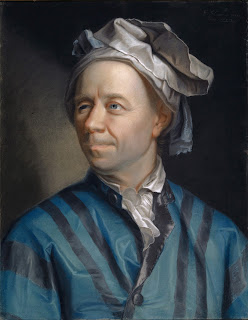
LEONHARD EULER
I know I already wrote about him in the shrine page (see "shrine page"), but if we are gonna talk about number theory, we HAVE to write about him. Otherwise this entire page would be insufficient.
Technically it is called the "Euler product formula", but it features the zeta function. And I already have enough professors breathing down my neck, so have some mercy on me.